


AOD-9604 (10mg)
$80.00
In stock
Ships same-day if ordered before 12 PM EST. Estimated delivery: 2 - 5 days
AOD-10
Description
Chemical Information
Shipping Information
What Is AOD-9604?
AOD-9604 is a synthetic peptide fragment derived from the C-terminal end of human growth hormone (hGH), specifically amino acids 176–191. Unlike full-length hGH, AOD-9604 is designed to focus on fat metabolism pathways without stimulating IGF-1 or growth-related effects, making it of high interest in obesity and metabolic regulation studies.
This peptide is stable in lyophilized form and demonstrates excellent solubility in bacteriostatic water, making it easy to reconstitute and handle in laboratory environments. Researchers value AOD-9604 for its targeted lipolytic activity and its ability to separate metabolic action from mitogenic activity, which has been highlighted in preclinical models.
AOD-9604 is for research use only. Not for human consumption.
This compound is intended exclusively for in vitro or laboratory-based research.
AOD‑9604 Mechanism of Action (Based on Research)
AOD‑9604 is a synthetic, 16-amino acid peptide derived from the C-terminal segment (residues 176‑191) of human growth hormone (hGH), with a modified N‑terminal tyrosine.
As a synthetic peptide, AOD-9604 was engineered to retain hGH’s fat-burning (lipolytic) properties while minimizing growth-promoting and glycemic side effects. Preclinical studies and early-phase human trials show a distinct metabolic profile, but keep in mind that this peptide is currently for research use only.
Fat Metabolism
AOD‑9604 demonstrates targeted fat metabolism effects without influencing the growth-promoting IGF‑1 pathways. This research is currently being pursued in the following roles.
Enhanced Lipolysis in Obese Models
Chronic administration to obese mice significantly decreased weight gain and fat accumulation. In these models, AOD‑9604 elevated plasma glycerol levels, which is an established index of lipolysis, and increased overall fat oxidation rates [1].
These observations align closely with the effects of full-length hGH, but notably, AOD‑9604 does not impair insulin sensitivity, thus avoiding hyperglycemia and mitigating risk of glucose intolerance seen with hGH [2].
β₃‑Adrenergic Receptor Upregulation
A pivotal mechanism involves upregulating β₃-adrenergic receptor (β₃-AR) expression in adipose tissue, the primary receptor mediating lipolysis. Obese mice treated with AOD‑9604 exhibited restored β₃-AR RNA expression to levels similar to lean controls [1].
In β₃-AR knockout mice, chronic AOD‑9604 failed to reduce fat mass or increase plasma glycerol—confirming that the long-term lipolytic effects depend on functional β₃-AR signaling [3].
Interestingly, a single dose still increased fat oxidation and energy expenditure acutely, even in knockout models, suggesting additional β₃-AR independent pathways.
These findings support a dual pathway:
- β₃-AR-dependent chronically enhanced lipolytic sensitivity, and
- β₃-AR-independent acute boosts in energy expenditure and fat oxidation
In other words, AOD‑9604 increased fat breakdown (lipolysis) both immediately after dosing and over longer periods of use. This is thought to happen partly by boosting the activity of β₃‑adrenergic receptors, which help regulate fat metabolism in adipose (fat) tissue.
At the same time, AOD‑9604 also showed fat-burning effects even in models lacking these receptors, suggesting it may activate additional pathways involved in energy use and fat oxidation.
Importantly, unlike full-length human growth hormone (hGH), AOD‑9604 did not raise blood sugar or insulin levels in these studies, making it potentially safer for long-term metabolic research.
Research Applications (AOD‑9604 Benefits)
AOD‑9604 has been examined across multiple preclinical models, revealing several notable outcomes all described within a scientific, research-only framework.
Fat Loss & Lipolytic Effects
In a controlled 14-day study using obese ob/ob and C57BL/6J mice, both full-length human GH and AOD‑9604 were administered via osmotic pumps. Both treatments significantly inhibited weight gain compared to controls.
Importantly, AOD‑9604 was linked to increased fat oxidation and elevated plasma glycerol levels, both classic indicators of enhanced lipolysis and fat breakdown [4].
β₃‑Adrenergic Receptor Involvement
Chronic AOD‑9604 treatment restored β₃‑adrenergic receptor expression in adipose tissue of obese mice to levels seen in lean controls [1]. In β₃‑AR knockout mice, sustained fat loss was absent, confirming that long-term effects likely involve β₃‑AR.
Nevertheless, acute increases in energy expenditure and fat oxidation still occurred in knockouts, suggesting extra β₃‑independent mechanisms are at play.
Metabolic Regulation
AOD‑9604 treatment did not impair glucose metabolism in animal studies; in fact, euglycemic clamp experiments showed no increase in insulin resistance—a contrast to full-length hGH [5].
Selective early human trials reported modest reductions in visceral fat mass without affecting IGF‑1 levels, although later trials showed mixed outcomes.
Tissue Repair & Cartilage/Bone Support
In vitro and animal models (e.g., rabbit osteoarthritis), AOD‑9604 was associated with enhanced cartilage regeneration and increased collagen and proteoglycan production, especially when combined with hyaluronic acid [4].
This suggests potential benefits in cartilage and bone remodeling within controlled experimental settings.
AOD‑9604 Peptide Characteristics
- Molecular Formula: C₇₈H₁₂₃N₂₃O₂₃S₂
- CAS Number: 221231‑10‑3
- Amino Acid Sequence:
- Tyr–Leu–Arg–Ile–Val–Gln–Cys–Arg–Ser–Val–Glu–Gly–Ser–Cys–Gly–Phe (YLRIVQCRSVEGSCGF)
- Synonyms: AOD‑9604; Tyr‑hGH fragment 176–191; Lipotropin; UNII‑7UP768IP4M
- Molar Mass: Approximately 1,815.1 g/mol
- Storage Recommendations
- Store lyophilized powder at –20 °C or colder
- For reconstituted solutions: aliquot and store at –80 °C; use within 6 months (at –20 °C, use within 1 month)
- Solubility: slight in DMSO; reconstitute with sterile water or bacteriostatic water; gentle warming or sonication may help
AOD‑9604 vs Fragment 176‑191 vs CJC‑1295 (No DAC) Comparison
Feature | AOD‑9604 | hGH Fragment 176–191 | CJC‑1295 (No DAC) |
Type | Synthetic peptide (C-terminal hGH analog) | Natural hGH fragment | Synthetic GHRH analog |
Primary Mechanism | Enhances fat metabolism via β₃-adrenergic pathways (without GH axis activation) | Increases lipolysis by stimulating fat cell receptors | Stimulates pituitary GH release through GHRH receptor |
GH Axis Activation | No direct effect | Minimal to none | Yes – transient, pulsatile GH secretion |
Observed Effects in Research | Fat loss, improved lipid profile, cartilage repair | Reduced adipose accumulation, increased fat oxidation | Increased IGF‑1, muscle repair, improved recovery |
Safety Profile (Studies) | No effect on IGF‑1, insulin, or glucose levels in humans [1] | No glycemic effects observed in animals | May elevate IGF‑1; some GH-related side effects in prolonged use |
Duration of Action | Short-acting (daily dosing) | Short-acting (daily dosing) | Short (t1/2 ~30 mins), requires multiple weekly dosing |
Receptor Binding | Does not bind GH receptor | Binds receptors in adipose tissue (not GH receptor) | Binds GHRH receptor at pituitary |
Research Focus | Obesity, metabolic syndrome, cartilage health | Obesity, body composition changes | GH deficiency, muscle and tissue repair |
Additional Effects (Studies) | Promotes cartilage regeneration, may aid bone remodeling [2] | Supports energy mobilization and reduced adipogenesis | Synergistic GH/IGF‑1 release when paired with GHRPs like Ipamorelin |
Dosing Frequency | Daily (injections) | Daily (injections) | 1–3x/week (injectable) |
Research Stage | Preclinical + completed early human trials [1] | Preclinical + some Phase I/II studies | Widely used in animal models and clinical-grade research |
Approval Status | Not FDA-approved; investigational | Not approved; research only | Not approved; research only |
Disclaimer | Research use only. Not for human consumption. | Research use only. Not for human consumption. | Research use only. Not for human consumption. |
AOD-9604 Safety and Side Effects in Studies
AOD‑9604 has been investigated primarily in preclinical and early-stage human studies for its potential role in fat metabolism and cartilage repair. In these studies, the peptide has generally shown a favorable research profile, with minimal reported adverse effects at typical research dosages [2].
Animal models exploring the effects of AOD‑9604 have not reported significant toxicity or off-target hormonal activity. Notably, unlike full-length human growth hormone (hGH), AOD‑9604 does not appear to elevate IGF‑1 levels, nor does it significantly alter glucose metabolism or insulin sensitivity in vivo [1][2].
Human Study Observations (Exploratory Only)
In limited human trials assessing AOD‑9604 as a potential anti-obesity therapy, participants tolerated the compound well at a range of dosages (from 0.25 mg up to 3 mg daily) with no major adverse effects reported [3]. Long-term safety has not been fully established.
Importantly, no significant changes in insulin, cortisol, or fasting glucose levels were noted in these early studies.
Legal Disclaimer
This product is intended for laboratory research purposes only. AOD-9604 is not approved for human or veterinary use, and must not be used for diagnostic, therapeutic, or resale applications.
Researchers are solely responsible for handling this compound in accordance with all local laws, regulations, and institutional guidelines.
Certificate of Analysis (COA)
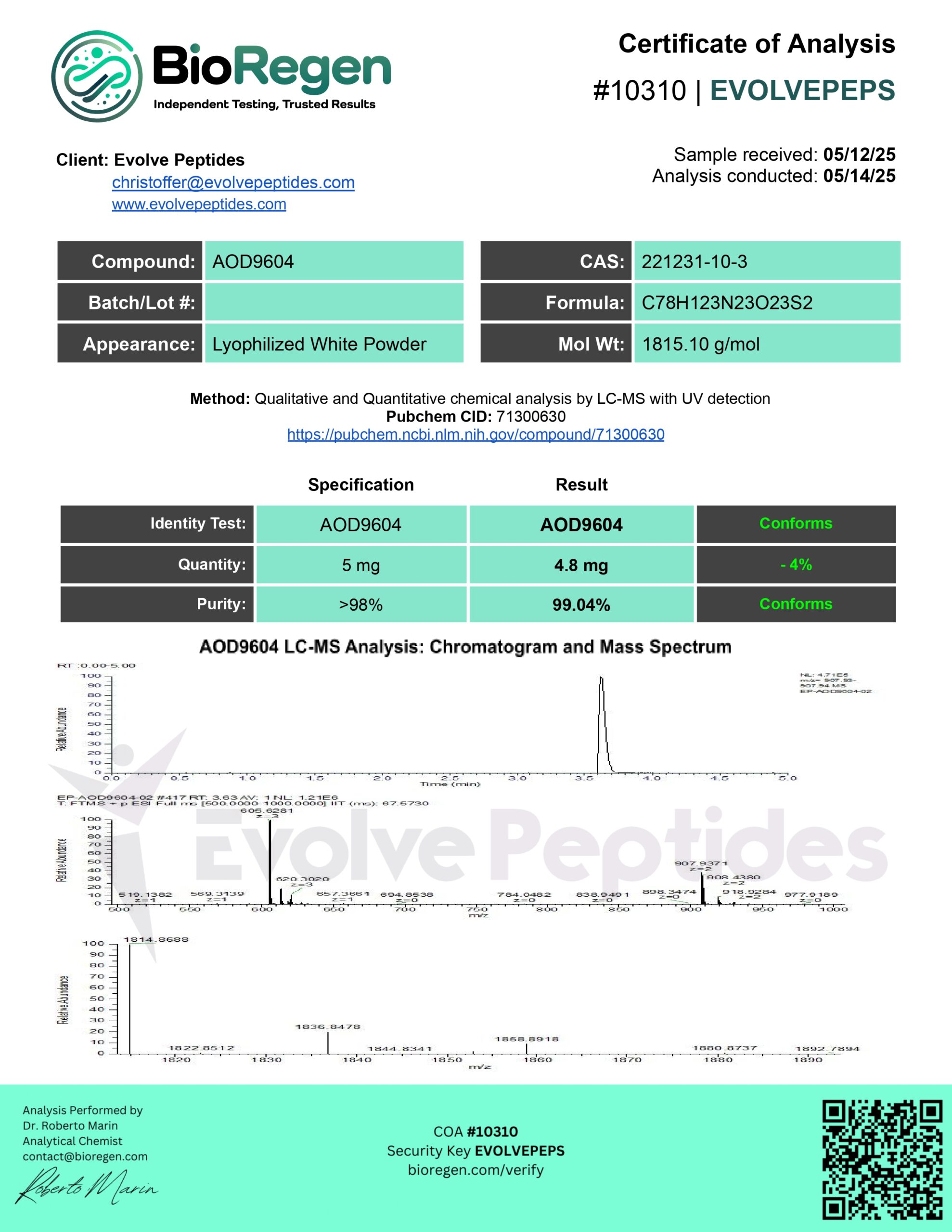
Every batch of AOD‑9604 peptide offered by Evolve Peptides undergoes independent third-party testing to verify identity, purity, and quality. COAs (Certificates of Analysis) are provided for transparency and are available to researchers upon request.
- Purity guaranteed to exceed 99% (verified by HPLC and mass spectrometry)
- Identity confirmed via peptide mapping and spectral analysis
- Sterility and endotoxin levels tested where applicable
You can request a PDF copy of the COA by contacting our support team or by checking the documentation provided in their shipment. All lab results come from accredited third-party laboratories to ensure data integrity and reproducibility.
Scientific References
- Heffernan, M., Ng, F. M., Connor, J. R., Brichta, A. M., Whitehead, J. P., Proietto, J., & Walder, K. (2001). The effects of human GH and its lipolytic fragment AOD9604 on lipid metabolism following chronic treatment in obese mice and β3-AR knock-out mice. Endocrinology, 142(11), 4809–4817. https://www.researchgate.net/publication/237315351_The_Effects_of_Human_GH_and_Its_Lipolytic_Fragment_AOD9604_on_Lipid_Metabolism_Following_Chronic_Treatment_in_Obese_Mice_and_3AR_Knock-Out_Mice
- Stier, H., Vos, E., & Kenley, D. (2013). Safety and tolerability of the hexadecapeptide AOD9604 in humans. Journal of Endocrinology and Metabolism, 3(1–2), 7–15. https://jofem.org/index.php/jofem/article/view/157/194
- Stuart, K., & U.S. Food and Drug Administration. (2024). Evaluation of AOD‑9604 (free base and acetate) for inclusion on the 503A bulks list – FDA briefing document [PDF]. FDA. https://www.fda.gov/media/183584/download
- Lim, M. C., Dornan, E. S., & Pepe, S. (2000). Increase of fat oxidation and weight loss in obese mice caused by a lipolytic fragment of human growth hormone (AOD9604) administered by mini-osmotic pump. International Journal of Obesity, 24(3), 309–318. https://www.nature.com/articles/0801740
- Liao, H.-J., Chen, H.-T., & Chang, C.-H. (2024). Peptides for targeting chondrogenic induction and cartilage regeneration in osteoarthritis. Cartilage. Advance online publication. https://pmc.ncbi.nlm.nih.gov/articles/PMC11556548/ PMID: 39291443
Contents: 10mg lyophilized (freeze-dried) powder provided in a 3 ml vial, sealed and sterile. Purity exceeds 99%, guaranteed.
Notes:Requires reconstitution with bacteriostatic water. (Sold Here:BAC Water.)
Chemical Formula: C78H123N23O23S2
PubChem CID: 71300630
CAS Number: 386264-39-7
Molecular Weight: 1815.12 g/mol
Storage:Store at 8C, sealed, away from heat, light, and moisture. The colder the better.
Purity:>99%
Orders placed before 1 PM EST ship same day.
We use USPS for most of our deliveries. You can expect your parcel within 2-5 business days from when it leaves our warehouse.
Why Choose Us?
Lyophilized in Texas – 99%+ Purity Guaranteed
Our peptides are proudly lyophilized right here in the US, to exact specifications. Strictly no compromises.
Rigorously Third-Party Tested, Always
Every product page includes independent lab test results for every peptide we sell.
We Respond in Minutes, Not Days
We take pride in providing excellent support – we're here for your total research success.
200% Money-Back Guarantee
Test our product – if purity doesn't match the label, we refund 200%. No questions asked.
Related products
-
 Save $90.00
Sema 10 mg
$219.90Original price was: $219.90.$129.90Current price is: $129.90.Save $90.00 -

 Save $80.00
Tirz 10 mg
$199.90Original price was: $199.90.$119.90Current price is: $119.90.Save $80.00 -

 Save $20.00
BPC-157 5 mg
$59.90Original price was: $59.90.$39.90Current price is: $39.90.Save $20.00
