

CJC-1295 & Ipamorelin Blend (5/5 mg)
$89.90 Original price was: $89.90.$72.90Current price is: $72.90.
In stock
Ships same-day if ordered before 12 PM EST. Estimated delivery: 2 - 5 days
CJCND-IPA-10
Description
Chemical Information
Shipping Information
What Is CJC-1295 & Ipamorelin Blend
The CJC-1295 & Ipamorelin blend is a synthetic research compound composed of two synergistic peptides: CJC-1295, a growth hormone–releasing hormone (GHRH) analog, and Ipamorelin, a selective growth hormone secretagogue (GHS).
When studied in combination, these peptides are commonly used in research models to evaluate their effects on pulsatile growth hormone release, muscle regeneration, and cellular repair pathways.
CJC-1295 CJC-1295 (without DAC) is a shorter-acting GHRH analog designed to stimulate growth hormone (GH) release in a more controlled and pulsatile manner, without the extended activity associated with DAC technology. Evolve Peptides offers CJC-1295 without DAC because it mimics the body’s natural pulsatile release of growth hormone more closely.
This is important to avoid GH saturation or desensitization and maintain a natural feedback loop (since long-acting versions can blunt this).
Our CJC-1295 and Ipamorelin blend is highly soluble in bacteriostatic water and shows strong stability under standard peptide storage conditions. It is considered valuable in preclinical investigations focused on tissue recovery, metabolic function, and age-related decline.
For research use only. Not for human consumption or therapeutic application.
Mechanism of Action: CJC-1295 & Ipamorelin (Based on Research)
The CJC-1295 & Ipamorelin blend exerts its effects by stimulating endogenous growth hormone (GH) release through two complementary pathways.
CJC-1295 (GHRH Analog)
CJC-1295 is a modified analog of growth hormone–releasing hormone (GHRH). It binds to GHRH receptors in the pituitary gland, enhancing the natural pulsatile release of GH.
Without the Drug Affinity Complex (DAC), CJC-1295 has a shorter half-life, promoting a more natural, pulsatile release of growth hormone (GH) in animal models. This allows for precise timing and flexibility in administration, without the prolonged stimulation seen in DAC-bound variants [1].
Ipamorelin (Ghrelin Mimetic)
Ipamorelin is a selective ghrelin receptor (GHS-R1a) agonist that stimulates GH release via the hypothalamic–pituitary axis.
Unlike earlier GHS compounds, Ipamorelin has demonstrated minimal interaction with cortisol or prolactin pathways, suggesting targeted GH stimulation with fewer off-target hormonal effects [2].
Synergistic Interaction
When combined, CJC-1295 and Ipamorelin work on different receptor systems—GHRH and ghrelin receptors—yet both promote GH secretion. This dual action results in amplified and sustained GH pulses, which are considered valuable in studies on muscle regeneration, cellular repair, lipid metabolism, and age-related endocrine decline.
These effects have been observed primarily in animal studies and in vitro models.
Research Applications of the CJC-1295 & Ipamorelin Blend
In preclinical and non-clinical studies, the CJC-1295 and Ipamorelin peptide combination has been investigated primarily for its impact on growth hormone dynamics, muscle repair, and cellular regeneration.
The dual mechanism—targeting both GHRH and ghrelin receptors—has made this blend a useful model for exploring GH-related physiological processes in vivo.
Muscle Recovery and Repair
In preclinical studies, the CJC-1295 and Ipamorelin blend has been explored for its potential to support muscle regeneration following injury, largely by enhancing growth hormone (GH) secretion and subsequently stimulating insulin-like growth factor 1 (IGF-1) production.
IGF-1 plays a key role in muscle hypertrophy, repair, and satellite cell activation—crucial processes in the regeneration of damaged tissue.
A landmark study by Teichman et al. (2006) found that administration of CJC-1295 in healthy adult males significantly increased both GH and IGF-1 levels over an extended period. The authors noted:
“Subcutaneous administration of CJC-1295 resulted in sustained, dose-dependent increases in GH and IGF-I levels in healthy adults.” [1]
This prolonged elevation mimics natural pulsatile GH release and offers a model for researchers studying the anabolic and regenerative effects of GH in muscle injury or degeneration scenarios.
Growth Hormone Release Support
CJC-1295 and Ipamorelin are both known to stimulate endogenous growth hormone (GH) release, but through distinct pathways.
CJC-1295, a GHRH analog, stimulates the pituitary gland over a prolonged period, while Ipamorelin, a GHRP analog, triggers GH release by mimicking ghrelin and activating the GHS-R1a receptor.
In research, this dual-pathway stimulation has been shown to result in synergistic GH pulses.
A study by Teichman et al. (2006) demonstrated that CJC-1295 could elevate GH and IGF-1 levels for nearly a week after a single dose, suggesting potential value in research contexts focused on long-acting hormone modulation.
Metabolic Pathway Research
GH pulses influence multiple aspects of metabolism, including hepatic glucose output, lipid oxidation, and insulin-like signaling. In research using animal models, GH analogs have been shown to increase mitochondrial activity and support energy metabolism regulation.
One study on GH-releasing peptides noted improved mitochondrial function and increased expression of genes associated with fatty acid oxidation in liver and muscle tissues in rats (Chang et al., 2016).
This makes the CJC-1295 & Ipamorelin blend a candidate for metabolic-focused studies, though much of the work is still exploratory.
Fat Metabolism and Body Composition
Animal research has explored how enhanced GH and IGF-1 levels may influence fat metabolism and lean mass.
For example, in a study involving rodents, treatment with the ghrelin receptor antagonist [D‑Lys³]‑GHRP‑6 led to notable reductions in adipose tissue alongside improvements in metabolic health.
Over the course of treatment, mice exhibited a significant decrease in fat mass, with no adverse effects on lean body mass. Histological and body composition analyses revealed that fat depots were markedly reduced, contributing to better glucose tolerance and insulin sensitivity.
While Ipamorelin has shown minimal impact on prolactin or cortisol levels compared to older GHRPs like GHRP-6, the CJC/Ipamorelin combination has gained attention in research settings for its targeted action and lower side-effect profile in preclinical comparisons.
Other Observed Applications in Animal Studies
- Sleep and Circadian Rhythm: Research suggests that GH-releasing peptides may influence sleep architecture, particularly by increasing slow-wave (deep) sleep in animal models.
- Tissue Regeneration: Due to IGF-1 activity, some studies suggest the blend may support cellular proliferation in connective tissues such as tendons or cartilage, though this is still under investigation.
- Neuroprotection: Early rodent studies have explored GH pathways in relation to neurogenesis and central nervous system recovery after injury.
CJC‑1295 & Ipamorelin Blend — Peptide Characteristics
- Molecular Formula
- CJC‑1295 (no DAC variant): C₁₅₂H₂₅₂N₄₄O₄₂
- Ipamorelin: C₃₈H₄₉N₉O₅
- CAS Number
- CJC‑1295: 863288‑34‑0
- Ipamorelin: 170851‑70‑4
- PubChem CID:
- CJC-1295 (No DAC): 91976842
- Ipamorelin: 9831659
- Amino Acid Sequence
- CJC‑1295 (no DAC variant): Tyr‑D‑Ala‑Asp‑Ala‑Ile‑Phe‑Thr‑Gln‑Ser‑Tyr‑Arg‑Lys‑Val‑Leu‑Ala‑Gln‑Leu‑Ser‑Ala‑Arg‑Lys‑Leu‑Leu‑Gln‑Asp‑Ile‑Leu‑Ser‑Arg‑N‑NH₂
- Ipamorelin: Aib‑His‑D‑2Nal‑D‑Phe‑Lys‑NH₂
- Synonyms
- CJC‑1295: CJC‑1295 Without DAC, CJC‑1295 Acetate
- Ipamorelin: Ipamorelin, NNC 26‑0161
- Molar Mass
- CJC-1295 (No DAC): ≈ 3,367.9 g/mol
- Ipamorelin: ≈ 711.868 g/mol
- Storage Recommendations
- Lyophilized powder: Store refrigerated at 46°F( –8 °C) or colder, in a dry, protected-from-light environment — ideal for long-term stability
- Reconstituted solution: Store at 36 °F – 46 °F (2–8 °C) and use within 30–45 days, or aliquot and freeze at 4 °F to -112 °F (–20 °C or –80 °C) to avoid freeze–thaw cycles
CJC-1295 + Ipamorelin vs Sermorelin + Ipamorelin vs MK-677 (Ibutamoren) Comparison
Feature | CJC-1295 + Ipamorelin | Sermorelin + Ipamorelin | |
Type | Peptide blend | Peptide blend | Peptide (GHRH analog) |
Mechanism | GHRH analog (CJC) + GHRP (Ipamorelin) | GHRH analog (Sermorelin) + GHRP (Ipamorelin) | Modified GHRH analog stimulating GH/IGF-1 |
Primary Targets | GH/IGF‑1 secretion, pulsatile GH studies | GH/IGF-1 secretion, anti-aging models | GH/IGF-1 secretion, visceral fat reduction |
Duration of Action | Short (~30–60 min half-life) | Short-acting (daily injections) | Short half-life (~26–38 min) |
Stimulation Profile | Pulsatile GH spikes; more physiologic control | Short GH pulse with synergistic effect | Pulsatile but daily, reducing visceral fat |
Research Focus | Muscle recovery, anti-aging, circadian GH studies | GH deficiency, aging, fitness recovery | HIV-related lipodystrophy, visceral fat loss, metabolic health |
Administration Route | Injectable (subcutaneous) | Injectable (subcutaneous) | Injectable (subcutaneous) |
Dosing Frequency | 2–3×/day (due to short half-life) | Daily | Daily injections |
Research Stage | Widely used in animal and cell models | Widely used in peptide aging research | Approved Rx (Egrifta) for HIV lipodystrophy; human clinical data |
Additional Observed Effects | Collagen support, fat metabolism, sleep quality (animal models) | Sleep, mood, energy recovery (animal studies) | Reduced visceral fat, improved body composition, metabolic benefits) |
Approval Status | Research use only | Research use only | FDA-approved (Rx) for HIV lipodystrophy |
Disclaimer | Research use only. Not for human consumption. | Research use only. Not for human consumption. | Prescription only. Not for off-label GH deficiency purposes. |
CJC-1295 + Ipamorelin Safety and Side Effects in Studies
In preclinical research, both CJC-1295 and Ipamorelin have demonstrated favorable tolerability profiles when used at standard research dosages. Animal model studies have generally not reported significant adverse effects under controlled experimental conditions.
CJC-1295 without DAC (also known as Modified GRF 1-29) is a shorter-acting GHRH analog that promotes a natural, pulsatile release of growth hormone (GH) without prolonged receptor stimulation.
Its shorter half-life allows for more physiologic GH pulses, which may help maintain normal feedback regulation of the GH axis in animal models. Ipamorelin, a selective growth hormone secretagogue (GHS), is frequently paired with it due to its ability to stimulate GH release without significantly affecting cortisol or prolactin levels — a benefit not seen with earlier compounds like GHRP-6 [1][2].
Importantly, most existing studies are limited to non-human models, with no long-term human safety data available. Reported effects such as mild water retention or localized irritation at injection sites are anecdotal and not confirmed by large-scale research.
Legal Disclaimer
This product is intended for laboratory research purposes only and is not approved for human or veterinary use.
Not for resale, diagnostic, or therapeutic applications.
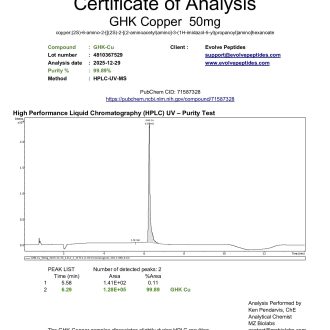
Certificate of Analysis (COA)
At Evolve Peptides, every batch of our CJC-1295 & Ipamorelin Blend undergoes rigorous third-party testing to confirm identity, purity, and quality. Results consistently exceed industry standards, with purity levels typically above 99%.
A Certificate of Analysis (COA) is available for each lot upon request. These documents verify:
- Peptide identity
- Purity and composition
- Absence of contaminants
For transparency and reproducibility in research, we are happy to provide sample COAs or downloadable PDFs. Please contact our customer support team or check your product shipment for batch-specific documentation.
Note: All COAs are issued by ISO-accredited third-party labs.
Scientific References
- Teichman, S. L., Neale, A., Lawrence, B., Gagnon, C., Castaigne, J.-P., & Frohman, L. A. (2006). Prolonged stimulation of growth hormone (GH) and insulin-like growth factor I secretion by CJC-1295, a long‑acting analog of GH‑releasing hormone, in healthy adults. The Journal of Clinical Endocrinology & Metabolism, 91(3), 799–805. https://doi.org/10.1210/jc.2005-1536
https://pubmed.ncbi.nlm.nih.gov/16352683/ - Ionescu, M., & Frohman, L. A. (2006). Pulsatile secretion of growth hormone (GH) persists during continuous stimulation by CJC‑1295, a long‑acting growth hormone–releasing hormone analog. The Journal of Clinical Endocrinology & Metabolism, 91(12), 4792–4797. https://doi.org/10.1210/jc.2006-1702
https://pubmed.ncbi.nlm.nih.gov/17018654/ - 3.Raun, K., Hansen, B. S., Johansen, N. L., Thøgersen, H., Madsen, K., Ankersen, M., & Andersen, P. H. (1998). Ipamorelin, the first selective growth hormone secretagogue. European Journal of Endocrinology, 139(5), 552–561. https://doi.org/10.1530/eje.0.1390552 https://pubmed.ncbi.nlm.nih.gov/9849822/
- Van Cauter, E., Leproult, R., & Plat, L. (2000). Age-related changes in slow-wave sleep and GH secretory patterns: Influence of GH secretagogues. Sleep, 23(Suppl 4), S12–S18. PMID:10690903 https://jamanetwork.com/journals/jama/fullarticle/192981
- Peterfi, Z., McGinty, D., Sarai, E., & Szymusiak, R. (2010). Growth hormone–releasing hormone activates sleep regulatory neurons of the rat preoptic hypothalamus. American Journal of Physiology–Regulatory, Integrative and Comparative Physiology, 298(1), R147–R156. https://journals.physiology.org/doi/full/10.1152/ajpregu.00494.2009
- Dahlgren, L. A., van der Meulen, M. C. H., Bertram, J. E. A., Starrak, G. S., & Nixon, A. J. (2002). Insulin-like growth factor‑I improves cellular and molecular aspects of healing in a collagenase‑induced model of flexor tendinitis. Journal of Orthopaedic Research, 20(5), 910–919. https://doi.org/10.1016/S0736-0266(02)00009-8
https://pubmed.ncbi.nlm.nih.gov/12382953/ - Olivares-Hernández, J. D., Balderas-Márquez, J. E., Carranza, M., Luna, M., Martínez-Moreno, C. G., & Arámburo, C. (2021). Growth hormone (GH) enhances endogenous mechanisms of neuroprotection and neuroplasticity after oxygen and glucose deprivation injury (OGD) and reoxygenation (OGD/R) in chicken hippocampal cell cultures. Neural Plasticity, 2021, Article 9990166. https://doi.org/10.1155/2021/9990166
https://onlinelibrary.wiley.com/doi/10.1155/2021/9990166 - Mosa, R., Huang, L., Li, H., Grist, M., LeRoith, D., & Chen, C. (2018). Long-term treatment with the ghrelin receptor antagonist [d‑Lys³]-GHRP‑6 does not improve glucose homeostasis in nonobese diabetic MKR mice. American Journal of Physiology – Regulatory, Integrative and Comparative Physiology, 314(1), R71–R83. https://doi.org/10.1152/ajpregu.00157.2017 https://journals.physiology.org/doi/10.1152/ajpregu.00157.2017
Contents: 10 mg lyophilized (freeze-dried) powder provided in a 3 ml vial, sealed and sterile. Purity exceeds 99%, guaranteed.
Notes: Requires reconstitution with bacteriostatic water. (Sold here: BAC Water.)
Chemical Formula:
CJC-1295 (No DAC): C152H252N44O42
Ipamorelin: C38H49N9O5
PubChem CID:
CJC-1295 (No DAC): 91976842
Ipamorelin: 9831659
CAS Number:
CJC-1295 (No DAC): 446036-97-1
Ipamorelin: 170851-70-4
Molecular Weight:
CJC-1295 (No DAC): 3367.954 g/mol
Ipamorelin: 711.868 g/mol
Storage: Store at ≤8°C, sealed, away from heat, light, and moisture. The colder the better.
Overall Purity: >99%
Orders placed before 1 PM EST ship same day.
We use USPS for most of our deliveries. You can expect your parcel within 2-5 business days from when it leaves our warehouse.
Why Choose Us?
Lyophilized in Texas – 99%+ Purity Guaranteed
Our peptides are proudly lyophilized right here in the US, to exact specifications. Strictly no compromises.
Rigorously Third-Party Tested, Always
Every product page includes independent lab test results for every peptide we sell.
We Respond in Minutes, Not Days
We take pride in providing excellent support – we're here for your total research success.
200% Money-Back Guarantee
Test our product – if purity doesn't match the label, we refund 200%. No questions asked.
Related products
-
 SOLD OUT
 -
-

 Save $25.00
BPC-157 10 mg
$79.90Original price was: $79.90.$54.90Current price is: $54.90.Save $25.00