


Cagrilintide (10mg)
$150.00
In stock
Ships same-day if ordered before 12 PM EST. Estimated delivery: 2 - 5 days
CAG-10
Description
Chemical Information
Shipping Information
What is Cagrilintide?
Cagrilintide is a synthetic research peptide designed to mimic and enhance the effects of amylin, a naturally occurring hormone involved in appetite regulation and energy balance. Structurally, it is an amylin analog modified for increased half-life, receptor activity, and stability in experimental models.
In research settings, Cagrilintide is studied for its potential to modulate satiety signals, slow gastric emptying, and influence weight-related metabolic pathways. Its enhanced formulation offers high water solubility and resistance to enzymatic degradation, making it well-suited for long-term and repeatable studies.
Note: Cagrilintide is for research use only. Not for human or veterinary consumption.
Cagrilintide Mechanism of Action (Based on Research)
Cagrilintide (AM833) is a synthetic, long‑acting analog of amylin, engineered to activate both amylin receptors (AMYRs) and to a lesser extent calcitonin receptors (CTR).
Activation of AMYRs and CTRs
Cagrilintide is a long-acting, synthetic analog of the human hormone amylin, which is co-secreted with insulin by pancreatic beta cells.
While native amylin plays a role in regulating appetite, slowing gastric emptying, and modulating glucagon release, it is rapidly degraded in the body. Cagrilintide was engineered for enhanced receptor selectivity and prolonged half-life, making it a promising compound in preclinical studies on appetite regulation and weight management.
It also engages calcitonin receptors, contributing to modulation of energy balance and potentially enhancing metabolic effects
Effects on Satiety and Appetite
Cagrilintide’s primary mechanism involves acting on key regions of the brainstem involved in energy balance and appetite control, specifically the area postrema and the nucleus tractus solitarius (NTS).
These centers are critical in processing satiety signals, and their activation is associated with reduced food intake and altered feeding behavior. Studies suggest that Cagrilintide not only diminishes hunger but also shifts food preference, indicating potential effects on both homeostatic and hedonic pathways of appetite control.
That’s because cagrilintide stimulates neurons in the area postrema (AP) and nucleus tractus solitarius (NTS), which are key brainstem sites involved in regulating fullness and eating behavior and leading to reduced food intake and shifts in food preference [1].
Cagrilintide also influences both homeostatic (hunger-signaling) and hedonic (reward-related) pathways, supporting changes in eating behavior and feeding motivation.
Gastric Emptying & Glucagon Modulation
In addition to suppressing appetite, Cagrilintide has been shown to delay gastric emptying, which prolongs the feeling of fullness after eating.
This effect is consistent with the actions of native amylin and is thought to contribute significantly to its weight-reducing potential. Moreover, Cagrilintide may also suppress postprandial glucagon secretion, thereby helping regulate blood glucose levels. It does this indirectly, through amylin receptor-mediated pathways, rather than by binding to glucagon receptors themselves [2].
Synergy with GLP‑1 Analogs (e.g. Semaglutide)
One area of growing interest in research is the synergistic potential of Cagrilintide when used in combination with GLP-1 receptor agonists, such as semaglutide.
While GLP-1 analogs act on different receptors to reduce appetite and enhance insulin secretion, their mechanism is complementary to that of Cagrilintide.
Preclinical data from combination studies (notably in the investigational drug “CagriSema”) indicate additive effects on both weight reduction and glycemic control, without significant overlap in adverse effect profiles [3][4][5].
Cagrilintide Research Applications (Cagrilintide Benefits)
Cagrilintide is gaining attention in metabolic research for its promising effects on weight loss, appetite regulation, and glycemic control. By mimicking the hormone amylin, Cagrilintide enhances satiety, slows gastric emptying, and reduces food intake, making it a valuable candidate in the treatment of obesity and type 2 diabetes.
Ongoing clinical trials and combination studies, particularly with GLP-1 receptor agonists like semaglutide, are exploring its potential to deliver additive benefits without increasing adverse effects.
Weight Loss and Appetite Regulation in Pre‑clinical Models
In rodent studies, cagrilintide demonstrated robust appetite suppression and body weight reduction that significantly exceeded placebo. In diet‑induced obese rats receiving 10 nmol/kg/week, researchers observed a 20–25 % reduction in food intake and around 15 % weight loss over just four weeks.
One study reported an 18 % reduction in visceral fat and improved glucose tolerance in mice, where body weight declined by 12–15 % and AUC glucose responses improved by about 20 % over six weeks [3][4][5].
These preclinical findings highlight the strong metabolic effects of Cagrilintide in animal models, particularly its ability to reduce food intake, body weight, and visceral fat while enhancing glucose regulation.
Enhanced Weight Loss Efficacy with GLP‑1 Combination (CagriSema)
When paired with semaglutide, cagrilintide showed additive effects in both weight and glycemic control. In rodents, concurrent or sequential dosing of AM833 (cagrilintide) with semaglutide produced weight loss of ~13 %, compared to ~6 % for each monotherapy group, and normalized body weight to lean controls in certain models [6].
Similarly, in a human Phase 2 trial involving individuals with type 2 diabetes, the investigational combination “CagriSema” (2.4 mg weekly of each agent) yielded ~17 % body weight loss after 20–32 weeks, which is higher than monotherapies such as semaglutide alone (10 %) or cagrilintide alone (8 %) [3].
Emerging Cardiometabolic and Other Research Directions
Although much of the current data focus on weight regulation and glycemic control, emerging avenues include potential effects on lipid metabolism, inflammatory markers, and cardiovascular risk parameters.
Pre‑clinical literature suggests amylin analogs like cagrilintide may modulate lipid profiles and inflammatory signaling, prompting interest in broader metabolic research applications [7].
There is also exploratory discussion around its possible relevance in neurodegenerative models, cachexia, and gastrointestinal motility disorders—though these areas remain at an early research phase.
Cagrilintide Peptide Characteristics
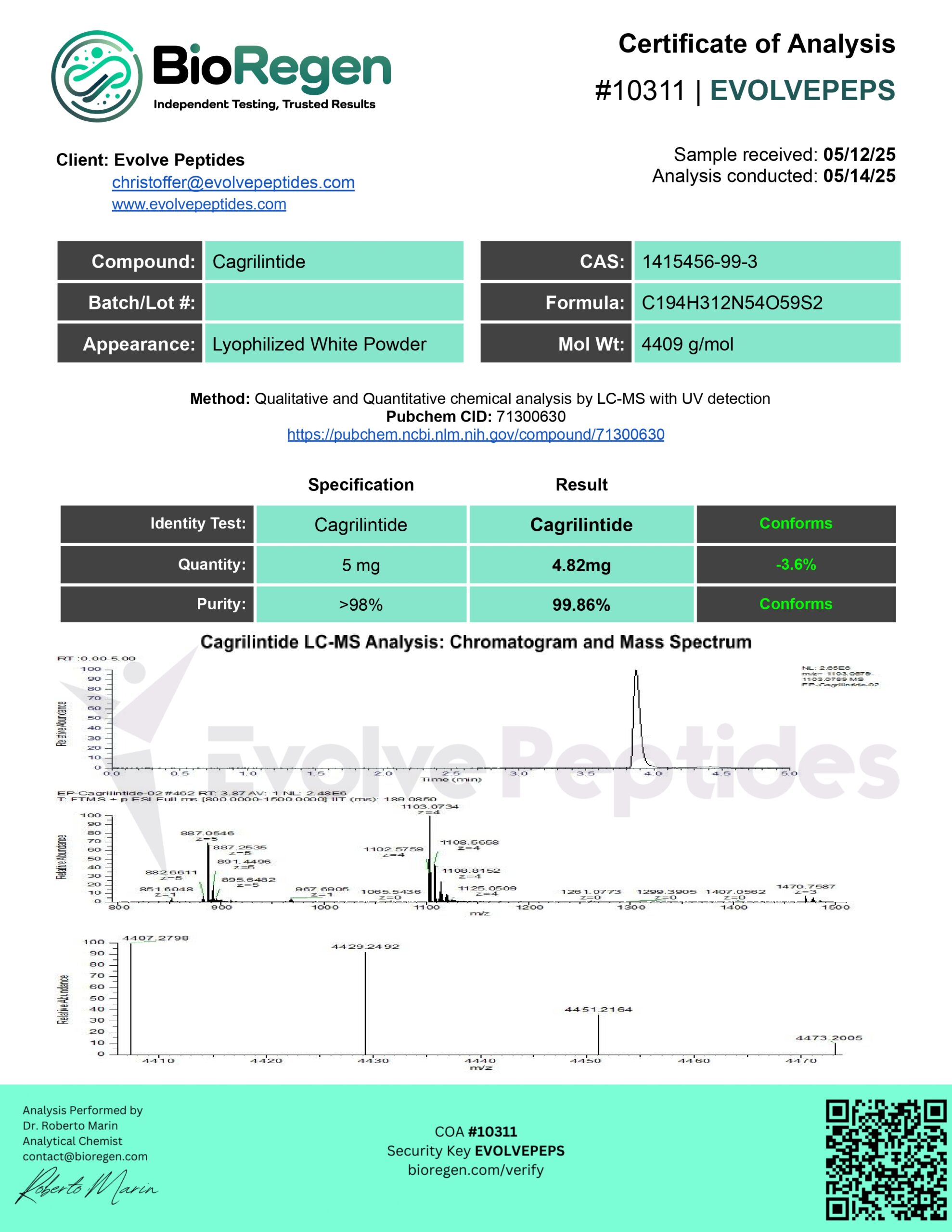
- Molecular Formula: C₁₉₄H₃₁₂N₅₄O₅₉S₂
- Molar Mass: ~4409.0 g/mol
- CAS Number: 1415456‑99‑3
- Amino Acid Sequence:
- {Eicosanedioic‑acid‑γ‑Glu}‑Lys‑Cys‑Asn‑Thr‑Ala‑Thr‑Cys‑Ala‑Thr‑Gln‑Arg‑Leu‑Ala‑Glu‑Phe‑Leu‑Arg‑His‑Ser‑Ser‑Asn‑Asn‑Phe‑Gly‑Pro‑Ile‑Leu‑Pro‑Pro‑Thr‑Asn‑Val‑Gly‑Ser‑Asn‑Thr‑Pro‑NH₂ (with a disulfide bridge between Cys‑3 and Cys‑8)
- Synonyms: Cagrilintide, AM833, AT42613, GLXC‑26801, NN9838
- Solubility: Water-soluble; solubility can be enhanced via mild heating (37 °C) or ultrasonic bath to aid dissolution in aqueous buffers
- Storage Recommendations:
- Lyophilized Powder: Stored at –4 °F (–20 °C) or lower, protected from light and moisture.
- Reconstituted Solution: Use promptly or store at 35–46 °F (2–8 °C) for up to 1 week.
- For long-term use, aliquot and freeze at –112 °F (–80 °C) to minimize freeze-thaw cycles.
Cagrilintide vs Pramlintide vs Petrelintide Comparison
Feature | Cagrilintide | Pramlintide | Petrelintide (ZP8396) |
Type | Dual agonist (Amylin + Calcitonin) | Single agonist (Amylin receptor only) | Dual amylin/calcitonin receptor agonist |
Targets | Satiety, delayed gastric emptying, glycemic modulation | Satiety, gastric emptying, glucagon suppression | Satiety, metabolic regulation (preclinical) |
Mechanism Complexity | Intermediate (dual receptor activity) | Simplest (single receptor pathway) | Similar to Cagrilintide (dual activity) |
Research Stage | Phase 2 combination trials ongoing | FDA‑approved diabetes adjunct (Symlin™) | Phase 1b in overweight/obese subjects |
Weight/Metabolic Effects (Research) | 6.0–10.8 % weight reduction in clinical and preclinical models, enhanced with semaglutide combination (up to 20–20.4 %) | Modest weight benefits in diabetes patients; slows gastric emptying and reduces post‑prandial glucose and glucagon | ~8.6 % weight loss over 16 weeks in Phase 1b trial; promising when combined with semaglutide |
Impact on Glucose Regulation | Glycemic control improved in combination and monotherapy settings (e.g., HbA1c reductions in trials with CagriSema) | Demonstrated reductions in post‑prandial glucose and HbA1c in type 1 & type 2 diabetes patients | Early-stage data hint at metabolic improvements; no glucose/HbA1c data publicly reported yet |
Additional Observed Effects | Lower incidence of nausea compared to pramlintide monotherapy; extended action via lipidation and albumin binding | Potential benefits on lipid biomarkers and oxidative stress; investigated in Alzheimer’s models | Preclinical synergy with semaglutide; being developed as fixed-dose combo for obesity/metabolic disorders |
Dosing Frequency | Once weekly (in trials) | Multiple daily injections (clinical) | Once-weekly dosing (Phase 1b dosing regimen) |
Approval Status | Not approved—research use only | FDA-approved for adjunctive diabetes use | Not yet approved—investigational |
Disclaimer | Research use only; not for human consumption | Approved for medical use in humans | Research use only; not approved for human use |
Cagrilintide Safety and Side Effects in Studies
In both preclinical animal models and early human trials, cagrilintide has demonstrated a generally favorable tolerability profile at research doses.
Across multiple Phase 2 studies, including those evaluating cagrilintide as a standalone treatment and in combination with semaglutide (“CagriSema”), the most commonly reported adverse events were gastrointestinal in nature—namely, nausea, vomiting, and reduced appetite.
These side effects mirrored the known profile of amylin and GLP‑1 receptor agonists and were typically dose-dependent, diminishing over time or when dose escalation was applied gradually [3][8].
For instance, in a large Phase 2 weight-management trial with weekly cagrilintide doses up to 4.5 mg (706 participants), nausea occurred in ~47%, vomiting in ~8%, and constipation in ~21%—most were mild-to-moderate and resolved with slower titration, with only a ~10% overall discontinuation rate.
In the Phase 1b combination study (cagrilintide 0.16–4.5 mg + semaglutide 2.4 mg), mild-to-moderate GI events were the primary adverse effects, consistent with expectations, and no unexpected safety issues emerged [9].
Legal Disclaimer
This product is intended for laboratory research purposes only and is not approved for human or veterinary use. It is not for resale, diagnostic, or therapeutic applications.
Evolve Peptides provides products strictly for research purposes; they are not intended for human consumption, medical, or therapeutic uses. None of the products should be mistaken for or substituted as prescription drugs.
The U.S. Food and Drug Administration has not evaluated any claims made on this site, and these products are not designed to diagnose, treat, cure, or prevent any disease.
By purchasing and using this product, the customer acknowledges responsibility for ensuring compliance with all applicable laws and regulations.
Certificate of Analysis (COA)
Each vial of Cagrilintide (and all peptides from Evolve Peptides) is linked to a specific batch’s Certificate of Analysis (COA) issued by independent third-party laboratories. These COAs confirm high purity (>99%) and verify product identity through rigorous testing methods such as HPLC and mass spectrometry.
A typical COA provides:
- Batch/Lot Information: Identifies the specific peptide lot you received
- Purity & Potency Results: Listing the percent purity confirmed via HPLC, as well as net peptide content versus impurities
- Contaminant Screen: Confirms absence of heavy metals, microbial contamination, and residual solvents
- Analytical Methods & Lab Accreditation: Specifies testing techniques used (e.g., HPLC‑UV, MS) and accreditation status of the testing lab
Evolve Peptides conveniently provides a download link or embedded PDF of the COA associated with each batch. This ensures full transparency and allows you to independently verify key quality metrics like purity, identity, and absence of contaminants.
Scientific References
- Kruse, T., Hansen, J. L., Dahl, K., Schäffer, L., Sensfuss, U., Lau, D. C. W., Erichsen, L., Francisco, A. M., Satylganova, A., Le Roux, C. W., McGowan, B., Pedersen, S. D., Pietiläinen, K. H., Rubino, D., & Batterham, R. L. (2022). Development of cagrilintide, a long‑acting amylin analogue. Current Opinion in Endocrinology, Diabetes and Obesity, 29(2), 183–190. https://www.sciencedirect.com/org/science/article/pii/S1520480421005482
- Hankir, M. K., & Le Foll, C. (2025). Central nervous system pathways targeted by amylin in the regulation of food intake. Biochimie, 229, 95–104. https://www.sciencedirect.com/science/article/pii/S0300908424002384
- Frias, J. P., Deenadayalan, S., Erichsen, L., Knop, F. K., Lingvay, I., Macura, S., Mathieu, C., Pedersen, S. D., & Davies, M. (2023). Efficacy and safety of co-administered once‑weekly cagrilintide 2·4 mg with once‑weekly semaglutide 2·4 mg in type 2 diabetes: a multicentre, randomized, double‑blind, active‑controlled, phase 2 trial. The Lancet, 402(10403), 720–730. https://www.thelancet.com/journals/lancet/article/PIIS0140-6736(23)01163-7/abstract
- JUAN P. FRIAS, SRIKANTH DEENADAYALAN, LARS ERICHSEN, FILIP K. KNOP, ILDIKO LINGVAY, STANISLAVA MACURA, CHANTAL MATHIEU, SUE D. PEDERSEN, MELANIE J. DAVIES; 53-OR: Efficacy and Safety of Coadministered s.c. Semaglutide and s.c. Cagrilintide in Type 2 Diabetes. Diabetes 20 June 2023; 72 (Supplement_1): 53–OR. https://diabetesjournals.org/diabetes/article/72/Supplement_1/53-OR/150035/53-OR-Efficacy-and-Safety-of-Coadministered-s-c
- Pharmacy Times. (2024, December 18). Co‑formulation of semaglutide and cagrilintide shows promise against diabetes and obesity. Pharmacy Times. Retrieved July 11, 2025, from https://www.pharmacytimes.com/view/co-formulation-of-semaglutide-and-cagrilintide-shows-promise-against-diabetes-and-obesity
- Çetin E, Pedersen B, Burak MF. Paradigm shift in obesity treatment: an extensive review of current pipeline agents. Turk J Med Sci. 2025 Jan 15;55(1):1-16. https://pmc.ncbi.nlm.nih.gov/articles/PMC11913498/
- Dutta D, Nagendra L, Harish BG, Sharma M, Joshi A, Hathur B, Kamrul-Hasan A. Efficacy and Safety of Cagrilintide Alone and in Combination with Semaglutide (Cagrisema) as Anti-Obesity Medications: A Systematic Review and Meta-Analysis. Indian J Endocrinol Metab. 2024 Sep-Oct;28(5):436-444. https://pmc.ncbi.nlm.nih.gov/articles/PMC11642503/
- Linu M John, Thomas Kruse, Kirsten Raun, Preclinical Weight Loss Efficacy of AM833 in Combination With Semaglutide in Rodent Models of Obesity, Journal of the Endocrine Society, Volume 5, Issue Supplement_1, April-May 2021, Page A54. https://academic.oup.com/jes/article/5/Supplement_1/A54/6240346
- Muhammad T, Pastore SF, Good K, Yu WH, Vincent JB. The role of amylin, a gut-brain axis hormone, in metabolic and neurological disorders. FASEB Bioadv. 2025 Jan 20;7(3):e1480. . https://pmc.ncbi.nlm.nih.gov/articles/PMC11886606/
- Huston, J., Vascimini, A., & Phillips, B. (2023). CagriSema: Emerging data on a new treatment option for patients with diabetes. Department of Pharmacotherapy & Translational Research, College of Pharmacy, University of Florida. https://juniperpublishers.com/jpcr/pdf/JPCR.MS.ID.555769.pdf
- Metabolic Health Digest. (2021, June 25). Safety, tolerability, pharmacokinetics and pharmacodynamics of concomitant administration of multiple doses of cagrilintide with semaglutide 2.4 mg for weight management: a randomised, controlled, phase 1b trial. Metabolic Health Digest. Retrieved July 11, 2025. https://metabolichealthdigest.com/safety-tolerability-pharmacokinetics-and-pharmacodynamics-of-concomitant-administration-of-multiple-doses-of-cagrilintide-with-semaglutide-24-mg-for-weight-management-a-randomised-contro/
Contents: 10 mg lyophilized (freeze-dried) powder supplied in a sterile, sealed 3 ml vial. Purity exceeds 99%, guaranteed.
Notes: Requires reconstitution with bacteriostatic water. (Sold here: BAC Water.)
Chemical Formula: C194H312N54O59S2·xC2H4O2
PubChem CID: 171397054
CAS Number: 1415456-99-3
Molecular Weight: 4409.01 g/mol
Storage: Store sealed at 8°C, away from heat, light, and moisture. Colder temperatures are recommended for optimal stability.
Purity: 99%
Orders placed before 1 PM EST ship same day.
We use USPS for most of our deliveries. You can expect your parcel within 2-5 business days from when it leaves our warehouse.
Why Choose Us?
Lyophilized in Texas – 99%+ Purity Guaranteed
Our peptides are proudly lyophilized right here in the US, to exact specifications. Strictly no compromises.
Rigorously Third-Party Tested, Always
Every product page includes independent lab test results for every peptide we sell.
We Respond in Minutes, Not Days
We take pride in providing excellent support – we're here for your total research success.
200% Money-Back Guarantee
Test our product – if purity doesn't match the label, we refund 200%. No questions asked.
Related products
-

 Save $80.00
Tirz 10 mg
$199.90Original price was: $199.90.$119.90Current price is: $119.90.Save $80.00 -

-

-
 Save $90.00
Sema 10 mg
$219.90Original price was: $219.90.$129.90Current price is: $129.90.Save $90.00