



NAD+ (500 mg)
$125.00
In stock
Ships same-day if ordered before 12 PM EST. Estimated delivery: 2 - 5 days
NAD-500
Description
Chemical Information
Shipping Information
NAD+ (Nicotinamide Adenine Dinucleotide) is a coenzyme found in all living cells that plays a critical role in energy production, mitochondrial function, and cellular signaling.
In research contexts, synthetic NAD+ is used to study cellular metabolism, oxidative stress, aging mechanisms, and DNA repair pathways.
The NAD+ for sale here at Evolve Peptides is a high-purity research compound engineered for optimal solubility, stability, and reproducibility across a range of experimental models. Its performance in redox-based studies, metabolic assays, and sirtuin-related research makes it a valuable tool for advanced cellular biology.
Important: This product is strictly intended for laboratory research use only. It is not approved for human consumption, therapeutic use, or diagnostic purposes. |
NAD+ Mechanism of Action (Based on Research)
NAD⁺ (Nicotinamide Adenine Dinucleotide) is an essential redox coenzyme and signaling molecule that participates in key biological processes related to cellular energy metabolism, DNA repair, and epigenetic regulation. It acts as a hydrogen and electron carrier in metabolic pathways, and as a substrate for NAD⁺-consuming enzymes involved in stress responses, gene expression, and aging.
Mitochondrial Energy Production
NAD⁺ plays a critical role in ATP generation by shuttling electrons in glycolysis, the TCA cycle, and oxidative phosphorylation. As NAD⁺ accepts electrons (becoming NADH), it helps drive the mitochondrial electron transport chain and maintain the cell’s energy balance [1].
Increased NAD⁺ availability has been associated with improved mitochondrial biogenesis and function, especially through its regulation of sirtuin pathways such as SIRT1 and SIRT3 [2].
DNA Repair and Genomic Stability
NAD⁺ serves as a key substrate for PARP (poly ADP-ribose polymerase) enzymes, which detect and initiate repair of single-strand DNA breaks. Depletion of cellular NAD⁺ levels is associated with impaired DNA repair capacity and cellular aging [3].
Restoring NAD⁺ levels in preclinical models has shown potential to enhance DNA repair mechanisms, particularly in the context of oxidative stress and age-related decline in genomic integrity [4].
Epigenetic and Cellular Stress Regulation
NAD⁺ directly activates sirtuins, a family of NAD⁺-dependent deacetylases that influence gene expression, stress resistance, inflammation, and metabolism. For example, SIRT1 has been shown to regulate transcription factors such as FOXO and PGC-1α, which control oxidative stress responses and mitochondrial dynamics [5].
Through sirtuin activity, NAD⁺ plays a central role in modulating inflammation, cell survival pathways, and metabolic homeostasis in non-clinical settings.
Research Applications (NAD⁺ Benefits)
In laboratory settings, NAD⁺ has been extensively studied for its role in cellular health, aging processes, and metabolic regulation. While not approved for therapeutic use, NAD⁺ has shown promise in multiple non-clinical studies, particularly in the following areas.
1. Cellular Aging and Longevity Pathways
One of the most intriguing aspects of NAD⁺ research is its involvement in metabolic regulation and age-related decline in cellular function.
NAD⁺ levels naturally decrease with age, which can impair mitochondrial efficiency and disrupt sirtuin activity, particularly SIRT1 and SIRT3, key regulators of energy metabolism and stress resistance.
In a 2014 review, Imai discusses findings from studies involving “BESTO” mice, a transgenic model with enhanced SIRT1 expression in pancreatic β-cells. These mice exhibited improved glucose-stimulated insulin secretion during early life stages, highlighting the metabolic benefits of sirtuin activation in youth.
“BESTO mice showed enhanced glucose-stimulated insulin secretion when they were young.”
— Shin-ichiro Imai., Trends in Cell Biology, 2014
While the study didn’t involve direct NAD⁺ supplementation, it supports the broader hypothesis that maintaining or restoring NAD⁺ levels may help sustain sirtuin function and metabolic health as organisms age.
2. Metabolic Health & Insulin Sensitivity
Preclinical research with NAD⁺ precursors like NMN highlights metabolic benefits in aging models. For instance, in a 2011 Cell Metabolism study:
- NMN supplementation ameliorated glucose intolerance in high-fat-diet mice
- It restored liver NAD⁺ levels, enhanced hepatic insulin sensitivity, reduced oxidative stress, and normalized circadian gene expression
Further, a long-term NMN study in aged mice showed improved insulin sensitivity and lipid profiles at doses of 100–300 mg/kg/day.
3. DNA Repair & Genomic Integrity
NAD⁺ acts as a substrate for PARP enzymes involved in detecting DNA damage. In oxidative stress models, enhanced NAD⁺ availability has been linked to improved DNA repair and maintenance of genomic integrity.
While more controlled studies are needed, current lab data suggest restoration of NAD⁺ levels helps protect cells from age-related genomic instability.
4. Neurodegeneration & Cognitive Function
Animal studies suggest NAD⁺ or its precursors may support neural health and counteract age-related cognitive decline. For instance, in a mouse model of Alzheimer’s disease:
“NAD+ ameliorated cognitive impairment and dampened neuroinflammation in CCH models in vivo and in vitro, and these beneficial effects were associated with mitochondrial protection and ROS inhibition via activating Sirt1/PGC-1α pathway.”
— Zhao, Y et al, 2021
This effect was linked to activation of the SIRT1/PGC‑1α pathway, underscoring NAD⁺’s role in maintaining brain metabolism and cellular resilience during injury or hypoxia.
Note: These findings are based on animal and in vitro models. NAD⁺ is not approved for human use and should not be interpreted as having clinical efficacy. |
Other NAD⁺ Research Applications
In addition to aging, neurodegeneration, metabolism, and DNA repair, NAD⁺ has been explored in several other preclinical and cellular study areas.
Immune Function & Inflammation
NAD⁺ regulates macrophage metabolism and immune responses. For example, macrophage-intrinsic NAD⁺ production via the kynurenine pathway is essential for proper mitochondrial function and cytokine balance—blocking this synthesis impairs phagocytosis and disrupts inflammation resolution.
Furthermore, NAD⁺-dependent pathways influence both innate and adaptive immune cell behavior, regulating inflammation in models such as COVID-19.
Cardiovascular & Vascular Health
In preclinical cardiovascular studies, NAD⁺ precursors have demonstrated vascular benefits such as improving endothelial function, reducing arterial stiffness, and protecting against ischemia-reperfusion damage.
Notably, airway endothelial NAD⁺ decline via CD38 upregulation contributes to hypertension; boosting NAD⁺ levels in mouse models lowered blood pressure and improved vascular response.
Cardio-Renal Axis & Kidney Protection
Early preclinical research indicates that strategies to restore NAD⁺, through precursors or enzyme modulation, can offer protection in heart-kidney interaction models. They show promise in reducing inflammation and oxidative stress in both organs.
Note: NAD⁺ is strictly meant for laboratory research only, and is not approved for human or veterinary use. |
NAD⁺ Peptide Characteristics
- Molecular Formula: C₂₁H₂₇N₇O₁₄P₂ (oxidized form of NAD⁺)
- CAS Number: 53‑84‑9
- PubChem CID: 5892
- Amino Acid Sequence: Not applicable – NAD⁺ is a coenzyme, not a peptide
- Chemical Formula: C21H27N7O14P2
- Synonyms: NAD⁺, β‑NAD, β‑Nicotinamide Adenine Dinucleotide, DPN
- Molar Mass: 663.4 g/mol (oxidized form)
- Storage Recommendations
- Lyophilized powder: Store at –20 °C in a tightly sealed, desiccated container for long-term stability
- Reconstituted solution: Stable for ~1 month at 4 °C (pH 2–6); for extended storage, aliquot and freeze at –70 °C; avoid repeated freeze-thaw cycles
NAD⁺ vs NMN vs NR (Comparison Table)
Feature | NAD⁺ | NMN (Nicotinamide Mononucleotide) | NR (Nicotinamide Riboside) |
Compound Type | Coenzyme | NAD⁺ precursor | NAD⁺ precursor |
Primary Role in Research | Direct support of redox reactions, mitochondrial health, DNA repair | Boosts NAD⁺ via salvage pathway | Boosts NAD⁺ via NRK pathway |
Conversion Pathway | Directly usable by cells (some limitations on cell permeability) | Converted to NAD⁺ via NMNAT enzymes | Converted to NMN, then to NAD⁺ |
Research Focus Areas | Aging, energy metabolism, DNA repair, neuroprotection | Aging, insulin sensitivity, metabolic disorders | Neurodegeneration, mitochondrial function, muscle regeneration |
Bioavailability (Preclinical Studies) | Lower (may require delivery modifications) | Moderate to high | High (particularly in liver and muscle) |
Mechanism Complexity | Direct NAD⁺ participation | Intermediate (salvage pathway) | Multi-step (NRK > NMN > NAD⁺) |
Research Stage | Widely studied, less bioavailable | Extensive animal data, human trials ongoing | Human trials completed (e.g. NIAGEN®) |
Dosing Frequency in Studies | Daily or intermittent | Daily | Daily |
Form Used in Studies | Injectable or liposomal | Oral | Oral |
Approval Status | Research use only | Dietary supplement (gray area), | Dietary supplement (gray area), |
Disclaimer | Not for human use | Not FDA Approved for human consumption but regularly used as a dietary supplement. | Not FDA Approved for human consumption but regularly used as a dietary supplement. |
(NAD⁺) Safety and Side Effects in Studies
Most studies investigating NAD⁺ supplementation or administration have been conducted in preclinical models, including rodents and in vitro systems. These studies generally report a low incidence of adverse effects at research-level dosages.
In animal studies, NAD⁺ has been administered both intraperitoneally and intravenously, often over extended periods, to evaluate its impact on aging, metabolic health, and neuroprotection.
At commonly used research concentrations, no significant toxicity or organ damage has been observed. In some studies, high doses were associated with mild metabolic changes, but no systemic toxicity was reported.
However, it’s important to note that NAD⁺ is not currently approved for human consumption or therapeutic use outside of specific investigational contexts.
While some NAD⁺ precursors (such as NMN and NR) are often marketed as dietary supplements their regulatory status differs. Pure NAD⁺ products offered for laboratory use are strictly intended for research purposes only.
Certificate of Analysis (COA)
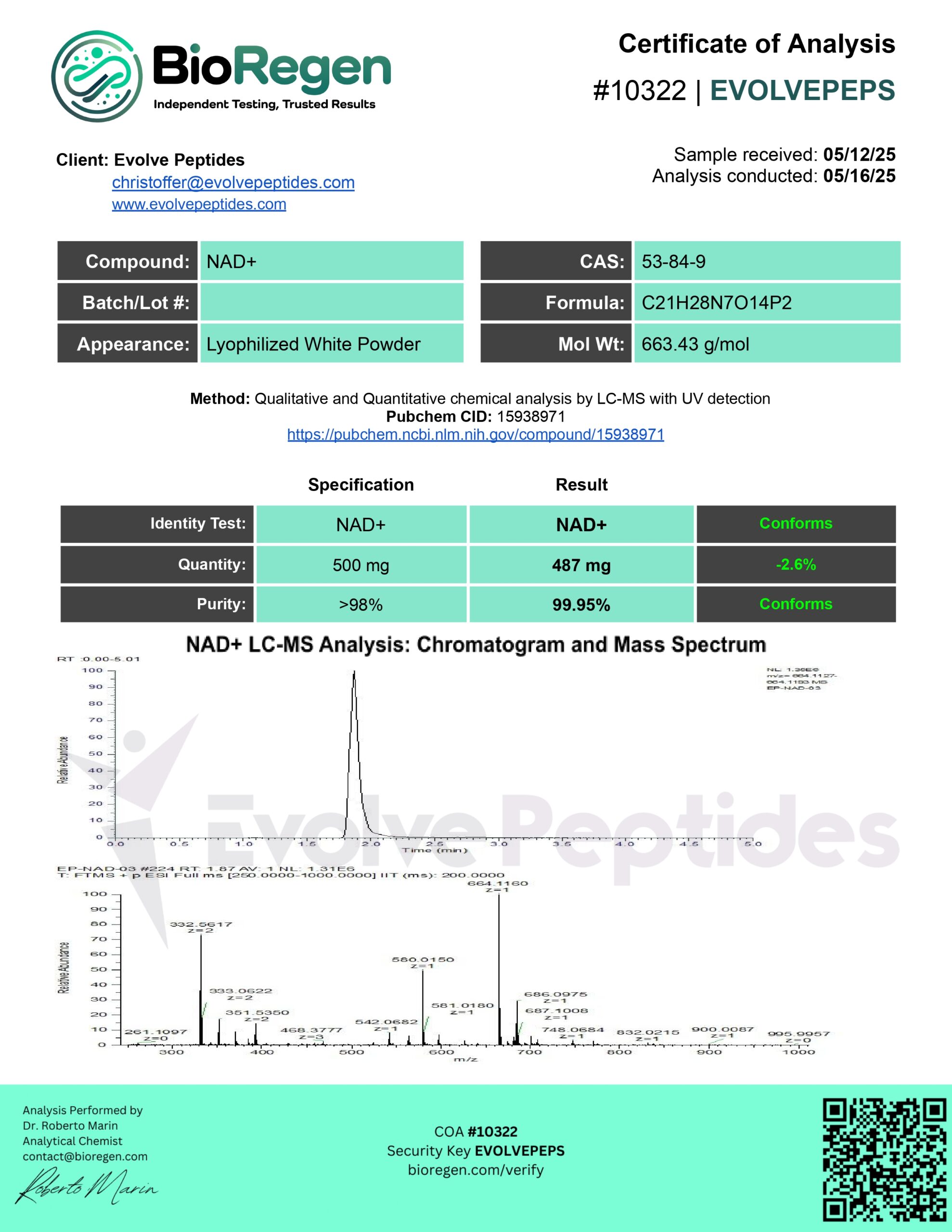
At Evolve Peptides, every batch of NAD⁺ is tested by an independent third-party laboratory to confirm identity, purity, and quality. Our COAs consistently show purity levels exceeding 99%, supporting the integrity and reproducibility of your research.
A Certificate of Analysis is available upon request or can be downloaded directly from the product page when available. Each COA includes:
- Product name and lot number
- Analytical method used
- Purity percentage
- Test date and lab certification info
We maintain rigorous documentation standards to ensure transparency and trust for researchers across disciplines.
Please note that COAs are batch-specific. Refer to the product listing or contact support for the latest version associated with your order.
Legal Disclaimer
This product is intended for laboratory research purposes only and is not approved for human or veterinary use. Not for resale, diagnostic, or therapeutic applications.
Scientific References
- Yoshino, J., Mills, K., Yoon, M.J., Imai, S. (2011). Nicotinamide mononucleotide, a key NAD⁺ intermediate, treats the pathophysiology of diet- and age-induced diabetes in mice.
Cell Metabolism, 14(4), 528–536. https://www.cell.com/cell-metabolism/fulltext/S1550-4131(11)00346-9 - Ratajczak, J., Joffraud, M., Trammell, S. A. J., Ras, R., Canela, N., Boutant, M., Kulkarni, S. S., Rodrigues, M., Redpath, P., Migaud, M. E., Auwerx, J., Yanes, O., Brenner, C., & Cantó, C. (2016). Nicotinamide riboside opposes type 2 diabetes and neuropathy in mice. Nature Communications, 7, 13103. https://doi.org/10.1038/ncomms13103
- Gong, B., Pan, Y., Vempati, P., Zhao, W., Knable, L., Ho, L., Wang, J., Sastre, M., Ono, K., Sauve, A. A., & Pasinetti, G. M. (2013). Nicotinamide riboside restores cognition through an upregulation of proliferator-activated receptor-γ coactivator 1α regulated β-secretase 1 degradation and mitochondrial gene expression in Alzheimer’s mouse models.
Neurobiology of Aging, 34(6), 1581–1588. https://doi.org/10.1016/j.neurobiolaging.2012.12.005 - Rajman, L., Chwalek, K., Sinclair, D. (2018). Therapeutic potential of NAD⁺-boosting molecules: the in vivo evidence. Cell Metabolism, 27(3), 529–547. https://www.cell.com/cell-metabolism/fulltext/S1550-4131(18)30122-0
- Verdin, E. (2015). NAD⁺ in aging, metabolism, and neurodegeneration.
Science, 350(6265), 1208–1213. https://www.science.org/doi/10.1126/science.aac4854 - Imai, S.-I. (2014). The NAD World 2.0: The importance of the inter-tissue communication mediated by NAMPT/NAD⁺/SIRT1 in mammalian aging and longevity control. Trends in Cell Biology, 24(8), 464–471. https://pmc.ncbi.nlm.nih.gov/articles/PMC4112140/
- Zhang, H., Ryu, D., Wu, Y., Gariani, K., Wang, X., Luan, P., D’Amico, D., Ropelle, E. R., Lutolf, M. P., Aebersold, R., Schoonjans, K., Menzies, K. J., & Auwerx, J. (2016). NAD⁺ repletion improves mitochondrial and stem cell function and enhances life span in mice. Science, 352(6292), 1436–1443. https://www.science.org/doi/10.1126/science.aaf2693
- Covarrubias, A. J., Perrone, R., Grozio, A., & Verdin, E. (2021). NAD⁺ metabolism and its roles in cellular processes during ageing. Nature Reviews Molecular Cell Biology, 22, 119–141. https://www.nature.com/articles/s41580-020-00313-x
Contents: 500 mg lyophilized (freeze-dried) powder provided in a 10 ml vial, sealed and sterile. Purity exceeds 99%, guaranteed.
Notes:Requires reconstitution with bacteriostatic water. (Sold Here:BAC Water.)
Chemical Formula: C21H27N7O14P2
PubChem CID: 5892
CAS Number: 53-84-9
Molecular Weight: 663.43 g/mol
Storage:Store at 8C, sealed, away from heat, light, and moisture. The colder the better.
Purity:>99%
Orders placed before 1 PM EST ship same day.
We use USPS for most of our deliveries. You can expect your parcel within 2-5 business days from when it leaves our warehouse.
Why Choose Us?
Lyophilized in Texas – 99%+ Purity Guaranteed
Our peptides are proudly lyophilized right here in the US, to exact specifications. Strictly no compromises.
Rigorously Third-Party Tested, Always
Every product page includes independent lab test results for every peptide we sell.
We Respond in Minutes, Not Days
We take pride in providing excellent support – we're here for your total research success.
200% Money-Back Guarantee
Test our product – if purity doesn't match the label, we refund 200%. No questions asked.
Related products
-
 Save $15.00
CJC-1295 5 mg (No DAC)
$59.90Original price was: $59.90.$44.90Current price is: $44.90.Save $15.00 -

-

 Save $80.00
Tirz 10 mg
$199.90Original price was: $199.90.$119.90Current price is: $119.90.Save $80.00

