


L-Glutathione (1500mg)
$150.00
In stock
Ships same-day if ordered before 12 PM EST. Estimated delivery: 2 - 5 days
GSH-1500
Description
Chemical Information
Shipping Information
What is L-Glutathione?
L-Glutathione (GSH) is a tripeptide composed of glutamine, cysteine, and glycine. It occurs naturally in most eukaryotic cells and plays a central role in cellular redox balance, detoxification, and immune system regulation.
In research settings, it is widely studied for its role in protecting cells from oxidative damage, recycling antioxidants such as vitamin C and E, and influencing inflammatory and apoptotic signaling pathways.
L-Glutathione is available in both reduced (GSH) and oxidized (GSSG) forms, with the reduced form being the most biologically active. Evolve Peptides offers the reduced L-Glutathione form for advanced laboratory applications.
L-Glutathione has research applications in three key areas:
- Oxidative Stress Modulation: GSH acts as a major intracellular antioxidant, scavenging reactive oxygen species (ROS) and reactive nitrogen species (RNS).
- Detoxification Studies: Serves as a substrate for glutathione S-transferases (GSTs) in xenobiotic metabolism.
- Cell Health & Apoptosis Research: Regulates signaling related to cell proliferation, differentiation, and death.
L-Glutathione is highly soluble in water and exhibits good stability under refrigerated or ambient lab storage conditions when stored appropriately. Its well-characterized biochemical profile makes it a reliable tool in molecular biology, biochemistry, and pharmacology labs.
Note: L-Glutathione is for research use only. Not for human or veterinary use. Not approved for clinical or therapeutic applications. |
L-Glutathione Mechanism of Action (Based on Research)
L‑Glutathione (GSH) plays a central role in cellular redox regulation, detoxification, and signal transduction. Its mechanisms in research models can be broadly classified into antioxidant defense, detoxification of harmful metabolites, and redox signaling control.
1. Antioxidant Defense via Enzymatic Reduction of Peroxides
Glutathione serves as a co-substrate for glutathione peroxidase enzymes (GPx1–GPx4), catalyzing the reduction of hydrogen peroxide (H₂O₂) and organic peroxides into water and corresponding alcohols.
During this process, GSH is oxidized to glutathione disulfide (GSSG), which is then converted back to GSH by glutathione reductase using NADPH as a cofactor.
A 2020 review reports that 98% of glutathione in cells exists in the reduced (GSH) form, and that GPx, together with glutaredoxin systems, plays a central role in maintaining this redox balance by reducing peroxides and disulfide.
In vitro enzyme studies—including one with selenoglutathione—demonstrated that NADPH and glutathione reductase can reduce over 80% of 0.1 mM H₂O₂ via a GPx-like mechanism within minutes, highlighting the rapid scavenging ability of the GSH–GPx system [1].
This balanced enzymatic relay—GPx using GSH to neutralize peroxides, GSSG being recycled by glutathione reductase using NADPH—is the cornerstone of cellular antioxidant defense and redox regulation.
2. Non‑Enzymatic Detoxification and Thiol Protection
Glutathione (GSH) plays a crucial role not only in enzymatic antioxidant defense but also in direct, non‑enzymatic detoxification of reactive molecules and in safeguarding protein thiols. This phase of antioxidant activity encompasses several key mechanisms:
Direct Scavenging of Reactive Oxygen and Nitrogen Species
GSH can neutralize highly reactive species like hydroxyl radicals (•OH) and peroxynitrite (ONOO⁻), as well as lipid peroxidation byproducts such as malondialdehyde (MDA) and 4‑hydroxynonenal (4‑HNE) [2].
These latter compounds form when membrane lipids undergo oxidative damage by ROS and RNS—processes commonly observed in inflammation and cellular stress. By reacting directly with these aldehydes, GSH reduces their reactivity and prevents further cellular damage [3].
S‑Glutathionylation: Reversible Protection of Protein Thiols
Under oxidative stress, critical cysteine residues in proteins may undergo irreversible oxidation, impairing function. GSH protects against this through the formation of protein‑SS‑glutathione mixed disulfides, a process known as S‑glutathionylation.
This reversible modification both shields the thiol from permanent damage and serves as a regulatory redox “switch” in signaling pathways. It maintains protein thiol integrity and helps regulate enzymatic activity in response to changing redox conditions [4].
3. Maintenance of Redox Signaling and Cellular Homeostasis
Glutathione (GSH) plays a central role in maintaining the cellular redox environment, with the GSH:GSSG ratio—usually above 100:1 in healthy cells—serving as a key indicator of redox balance and oxidative stress [2]. This highly reduced state allows GSH to act as both a buffer and a signal mediator.
Reversible Thiol Modifications and Enzymatic Control
GSH engages in S‑glutathionylation, a reversible post-translational modification where a glutathionyl moiety forms mixed disulfides with protein cysteines.
This modification—catalyzed by enzymatic systems such as glutaredoxins—serves dual purposes of protection (prevents irreversible oxidation of sensitive thiol residues) and regulation (as a redox-controlled “switch” in proteins governing cell cycle, apoptosis, immune responses, and gene expression).
Biosynthesis and Regeneration Pathways of Glutathione
Glutathione (GSH) is synthesized in a highly conserved, two-step, ATP-dependent enzymatic process that ensures a steady supply of this critical antioxidant.
Step #1
Glutamate–Cysteine Ligase (GCL) catalyzes the condensation of L‑glutamate and L‑cysteine into γ‑glutamylcysteine. This is the rate-limiting step in GSH synthesis and is carried out by a heterodimer comprised of catalytic (GCLC) and modifier (GCLM) subunits. Genetic knockout of GCL subunits is lethal in mice, underscoring its essential biological role [5].
Step #2
Glutathione Synthase (GS) then adds glycine to γ‑glutamylcysteine, forming the tripeptide GSH. This step also consumes ATP and completes the biosynthetic pathway [6]. Together, these reactions require two ATP molecules per GSH molecule, sustaining millimolar concentrations of reduced glutathione in most cells.
Following oxidation—usually during peroxide detoxification—GSH is converted into glutathione disulfide (GSSG). Glutathione reductase (GSR), using NADPH as a cofactor, reduces GSSG back into two GSH molecules, thereby maintaining the cellular redox balance and allowing for continuous antioxidant activity [1].
L-Glutathione Research Applications
L‑Glutathione is among the most widely studied intracellular antioxidants, with diverse roles in redox regulation, detoxification, and cellular protection. Its applications in preclinical and biochemical research span multiple systems and disease models.
These are the most prominent areas.
Oxidative Stress and Antioxidant Pathways
Glutathione is central to research exploring how cells defend against oxidative stress. In both in vitro and animal models, GSH depletion correlates strongly with increased oxidative damage, mitochondrial dysfunction, and apoptosis [7].
Supplementing or preserving GSH levels has been shown to:
- Limit lipid peroxidation and DNA damage in oxidative stress models [8]
- Protect neurons in models of Parkinson’s and Alzheimer’s disease by reducing ROS levels
- Improve mitochondrial function and membrane stability
These findings make GSH essential in studies targeting aging, neurodegeneration, cardiovascular disease, and metabolic syndrome.
Detoxification and Hepatic Function Models
L‑Glutathione is extensively studied for its role in hepatic detoxification, particularly in research related to liver injury and xenobiotic metabolism [9]. In hepatocyte cultures and animal studies:
- GSH conjugation aids in metabolizing drugs, alcohol byproducts, and pollutants [10]
- Depletion of GSH enhances liver sensitivity to toxins like acetaminophen or aflatoxin
- GSH status is used as a biomarker of hepatic health and recovery potential
Thus, L-glutathione is valuable in toxicology and pharmacokinetic research.
Redox Regulation of Immune Function
Glutathione is a redox buffer in immune cells. Research has shown that low intracellular GSH levels impair lymphocyte activation and cytokine production.
Similarly, GSH modulates T-cell proliferation and helps prevent excessive inflammatory signaling. GSH also participates in antigen presentation and phagocytic function of macrophages.
These properties make it relevant in research on chronic inflammation, immune exhaustion, and autoimmune conditions.
Neuroprotection and Brain Health
Because neurons are highly susceptible to oxidative stress, GSH is a focus in neurological research. In vitro studies show that raising GSH levels reduces ROS-induced neurotoxicity.
In animal models, GSH depletion is linked to early neurodegeneration and cognitive decline. Thus, it may influence glutamate cycling and neurotransmitter balance indirectly.
Glutathione is frequently used as a benchmark compound in testing neuroprotective agents or antioxidants.
Cellular Aging and Longevity Research
L‑Glutathione is also explored in the context of aging due to its role in:
- Limiting mitochondrial damage over time
- Preserving DNA integrity by minimizing oxidative mutations
- Supporting proteostasis and redox-sensitive signaling cascades
Studies on caloric restriction and lifespan extension often measure or manipulate GSH levels as part of the cellular stress response pathway.
L-Glutathione Characteristics
- Chemical Name: L‑Glutathione (Reduced form)
- CAS Number: 70‑18‑8
- Molecular Formula: C₁₀H₁₇N₃O₆S
- Molecular Weight: ~307.32 g/mol
- Synonyms: GSH, γ‑L‑Glutamyl‑L‑cysteinylglycine, Reduced Glutathione
- Peptide Sequence: γ‑Glu‑Cys‑Gly (gamma‑Glutamylcysteinylglycine)
- Appearance: White to off-white crystalline powder
- Solubility: Highly soluble in water; slightly soluble in alcohol
- Purity: ≥99% (HPLC-verified; third-party tested)
- Storage recommendations:
- Store the lyophilized form at −20°C to −10°C (−4°F to 14°F) in a cool, dry, dark environment.
- Once reconstituted, store at 2°C to 8°C (36°F to 46°F) and use within a short time frame appropriate to your lab’s protocol.
- Avoid repeated freeze-thaw cycles to preserve stability and structure.
Glutathione vs NAC vs Alpha-Lipoic Acid Comparison
Feature | N‑Acetylcysteine (NAC) | Alpha-Lipoic Acid (ALA) | |
Type | Tripeptide antioxidant | Amino acid derivative (Glutathione precursor) | Organosulfur compound (fat‑ and water‑soluble antioxidant) |
Molecular Formula | C₁₀H₁₇N₃O₆S | C₅H₉NO₃S | C₈H₁₄O₂S₂ |
Molecular Weight | ~307.3 g/mol | ~163.2 g/mol | ~206.3 g/mol |
Primary Mechanism | Direct antioxidant & redox regulator via thiol group; glutathione peroxidase substrate | Boosts intracellular glutathione; scavenges ROS indirectly | Direct free radical scavenger and cofactor for mitochondrial enzymes |
Cellular Role | Reduces oxidative stress, maintains redox balance, supports detoxification | Enhances glutathione synthesis, supports mucolytic activity | Enhances mitochondrial function, reduces inflammation |
Research Applications | Antioxidant pathways, detoxification models, oxidative injury studies | Liver support models, respiratory inflammation, oxidative damage | Mitochondrial protection, neurodegeneration models, diabetic neuropathy |
Stability | Stable in lyophilized form; sensitive to oxidation in solution | Stable as a powder; hygroscopic, decomposes slowly in air | Stable under dry storage; sensitive to heat and light |
Solubility | Water-soluble | Highly water-soluble | Slightly soluble in water; more soluble in organic solvents |
Research Grade Usage | In vitro and ex vivo redox modeling | Oxidative injury, respiratory studies, precursor experiments | Aging, oxidative damage, diabetic cell models |
Disclaimer | Research use only | Research use only | Research use only |
L-Glutathione Safety & Stability
However, oxidation is a genuine concern: GSH degrades rapidly at room temperature in solution and should be stored cold in dry, oxygen-limited conditions for optimal stability.
Specifically, 200 µM solutions held at 25 °C showed a 15% loss, while those at 50 °C lost up to 67% within an hour [12]. Long-term stability is manageable when refrigerated: GSH solutions stored at 4–5 °C retained over 90% integrity for several weeks.
Legal Disclaimer
L-glutathione is intended strictly for laboratory research purposes only. It is not approved for human or veterinary use, and must not be used for diagnostic, therapeutic, or clinical applications.
By purchasing from Evolve Peptides, you acknowledge that you are a qualified researcher or acting under the supervision of a licensed professional. It is the customer’s responsibility to ensure proper handling, storage, and disposal in accordance with applicable laws and institutional protocols.
Certificate of Analysis (COA)
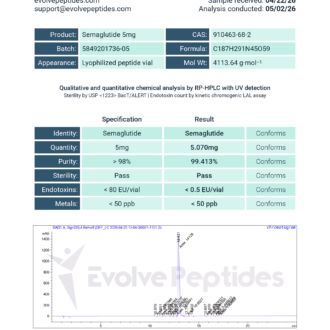
Each batch of L‑Glutathione is subjected to third-party testing to confirm identity, purity (≥99%), and quality specifications.
COAs are made available with every product shipment and can be requested directly by contacting Evolve Peptides. These include:
- Mass spectrometry and HPLC results
- Purity confirmation (≥99%)
- Batch number and production date
For sample documentation or specific lot information, please reach out to the friendly and highly experienced Evolve Peptides support team via our contact page.
Scientific References
- 1.Vašková, J., Kočan, L., Vaško, L., & Perjési, P. (2023). Glutathione-Related Enzymes and Proteins: A Review. Molecules, 28(3), 1447. https://www.mdpi.com/1420-3049/28/3/1447
- Vašková, J., Kočan, L., Vaško, L., & Perjési, P. (2023). Glutathione-Related Enzymes and Proteins: A Review. Molecules, 28(3), 1447. https://www.frontiersin.org/journals/pharmacology/articles/10.3389/fphar.2014.00196/full
- Lushchak, Volodymyr I., Glutathione Homeostasis and Functions: Potential Targets for Medical Interventions, Journal of Amino Acids, 2012, 736837, 26 pages, 2012. https://onlinelibrary.wiley.com/doi/10.1155/2012/736837
- Vašková, J., Kočan, L., Vaško, L., & Perjési, P. (2023). Glutathione-Related Enzymes and Proteins: A Review. Molecules, 28(3), 1447. https://www.mdpi.com/1420-3049/28/3/1447
- Lu SC. Glutathione synthesis. Biochim Biophys Acta. 2013 May;1830(5):3143-53. doi: 10.1016/j.bbagen.2012.09.008. Epub 2012 Sep 17. PMID: 22995213; PMCID: PMC3549305. https://pmc.ncbi.nlm.nih.gov/articles/PMC3549305/
- Maughan, S. and Foyer, C.H. (2006), Engineering and genetic approaches to modulating the glutathione network in plants. Physiologia Plantarum, 126: 382-397. https://onlinelibrary.wiley.com/doi/10.1111/j.1399-3054.2006.00684.x
- Marí M, Morales A, Colell A, García-Ruiz C, Fernández-Checa JC. Mitochondrial glutathione, a key survival antioxidant. Antioxid Redox Signal. 2009 Nov;11(11):2685-700. doi: 10.1089/ARS.2009.2695. PMID: 19558212; PMCID: PMC2821140. https://pmc.ncbi.nlm.nih.gov/articles/PMC2821140/
- Jasvinder Singh Bhatti, Gurjit Kaur Bhatti, P. Hemachandra Reddy, Mitochondrial dysfunction and oxidative stress in metabolic disorders — A step towards mitochondria based therapeutic strategies, Biochimica et Biophysica Acta (BBA) – Molecular Basis of Disease, Volume 1863, Issue 5, 2017, Pages 1066-1077, ISSN 0925-4439 https://www.sciencedirect.com/science/article/pii/S0925443916302927
- Chen, T.-H., Wang, H.-C., Chang, C.-J., & Lee, S.-Y. (2024). Mitochondrial Glutathione in Cellular Redox Homeostasis and Disease Manifestation. International Journal of Molecular Sciences, 25(2), 1314.https://www.mdpi.com/1422-0067/25/2/1314
- Ribas, V., García‑Ruiz, C., & Fernández‑Checa, J. C. (2014). Glutathione and mitochondria. Frontiers in Pharmacology, 5, Article 151. https://www.frontiersin.org/journals/pharmacology/articles/10.3389/fphar.2014.00151/full
- Campbell KC, Larsen DL, Meech RP, Rybak LP, Hughes LF. Glutathione ester but not glutathione protects against cisplatin-induced ototoxicity in a rat model. J Am Acad Audiol. 2003 Apr;14(3):124-33. PMID: 12859137. https://pubmed.ncbi.nlm.nih.gov/12859137/
- Nuhu F, Gordon A, Sturmey R, Seymour AM, Bhandari S. Measurement of Glutathione as a Tool for Oxidative Stress Studies by High Performance Liquid Chromatography. Molecules. 2020 Sep 13;25(18):4196. doi: 10.3390/molecules25184196. PMID: 32933160; PMCID: PMC7571047. https://pmc.ncbi.nlm.nih.gov/articles/PMC7571047/
Contents: 1500 mg lyophilized (freeze-dried) powder provided in a 20 ml vial, sealed and sterile. Purity exceeds 99%, guaranteed.
Notes: Requires reconstitution with reconstitution solution. (Sold here: Reconstitution Solution.)
Orders placed before 1 PM EST ship same day.
We use USPS for most of our deliveries. You can expect your parcel within 2-5 business days from when it leaves our warehouse.
Why Choose Us?
Lyophilized in Texas – 99%+ Purity Guaranteed
Our peptides are proudly lyophilized right here in the US, to exact specifications. Strictly no compromises.
Rigorously Third-Party Tested, Always
Every product page includes independent lab test results for every peptide we sell.
We Respond in Minutes, Not Days
We take pride in providing excellent support – we're here for your total research success.
200% Money-Back Guarantee
Test our product – if purity doesn't match the label, we refund 200%. No questions asked.
Related products
-

-

-
 SOLD OUT

